Data Connectors
Connect IoT, PLCs, cameras, fleets, databases, ERP, CRM, HR, TMS, WMS, APIs, files, and documents in one data layer.
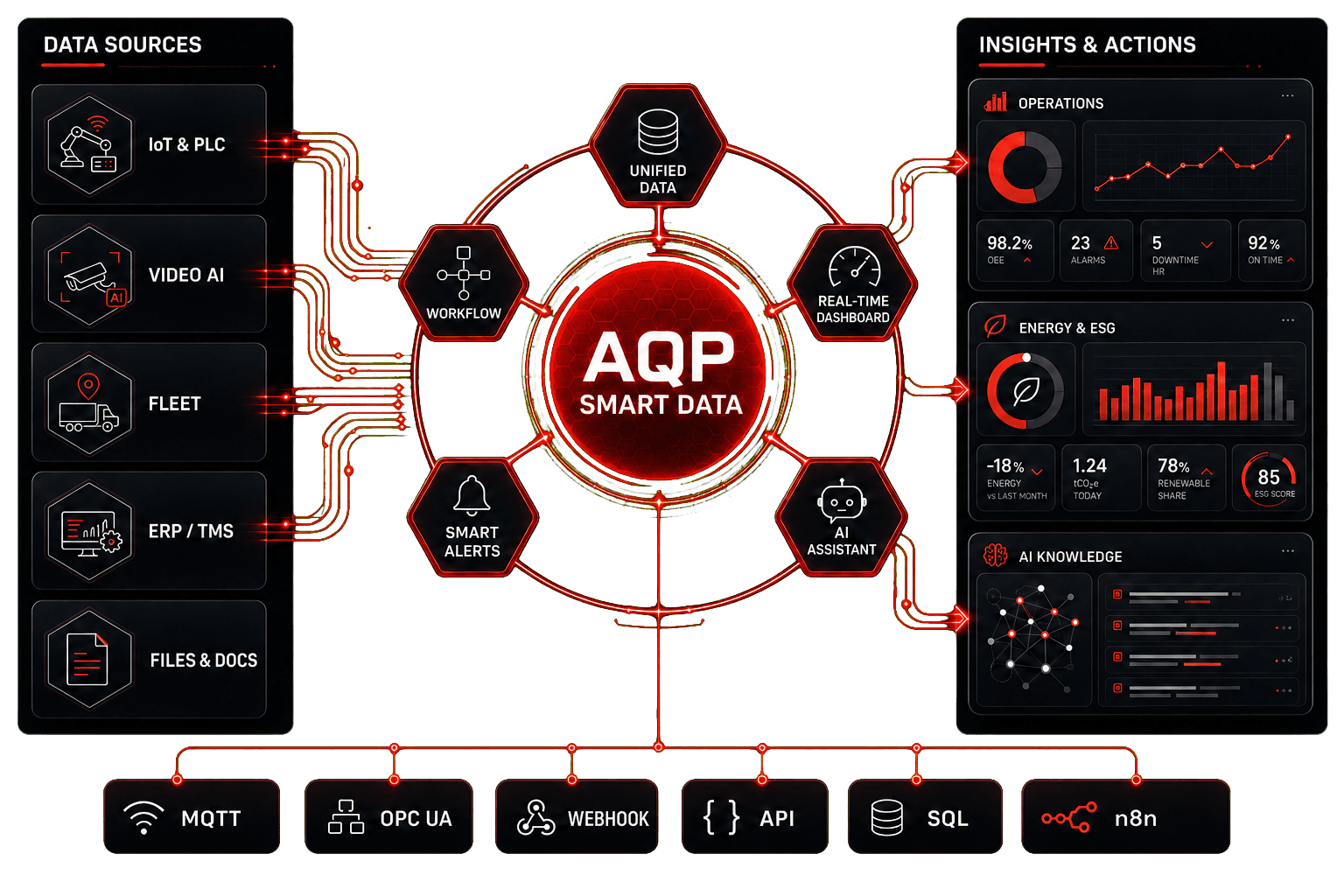
AQP Smart Data connects machinery, IoT, AI cameras, vehicles, software, and enterprise documents in one platform. Real-time dashboards, intelligent alerts, and an AI assistant help teams surface issues earlier, query operations in natural language, and turn information into action.
Operational data is scattered across devices, cameras, fleets, ERP, spreadsheets, and custom software
Reports are manually assembled, arrive late, and differ across departments
Managers lack one view across sites, assets, vehicles, and processes
Alerts stop at notification without ownership, SLA, or a next action
Internal knowledge is difficult to find and depends on a small number of experienced staff
AI cannot deliver governed value without context, permissions, and trusted sources
Configure modules around your data maturity, user roles, and operational objectives.
Connect IoT, PLCs, cameras, fleets, databases, ERP, CRM, HR, TMS, WMS, APIs, files, and documents in one data layer.
Monitor KPIs in real time by site, department, asset, vehicle, owner, or event type.
Detect connectivity loss, threshold breaches, anomalies, delivery risk, and overdue work, then notify the right channel.
Ask operational questions, compare performance, find causes, summarise activity, and create reports in natural language.
Turn SOPs, manuals, policies, technical records, and website content into a searchable, conversational knowledge source.
Create asset profiles, maintenance plans, inspections, QR/barcodes, parts records, and incident-history analysis.
Monitor electricity, water, fuel, baselines, and cost, with project-scoped emissions-data management.
Create tickets, assignments, escalations, scheduled reports, and n8n or enterprise workflow actions.
A layered architecture supports phased integration, data control, and expansion without disrupting current systems.
IoT, PLCs, machinery, cameras, AQP Vision™ Platform, AQP Fleet™ One, ERP, TMS, documents, and files.
→Ingest through MQTT, Modbus, OPC UA, HTTP, APIs, webhooks, or databases; normalise, authorise, and validate.
→Bring time-series, events, assets, video metadata, documents, vectors, and business relationships into shared context.
→Power dashboards, anomaly detection, knowledge search, AI assistants, agents, and automated reports.
→Use alerts, tickets, maintenance, chatbots, workflows, and APIs to turn insight into operational action.
Monitor machinery, output, OEE, energy, incidents, maintenance, and production data.
Connect goods, cameras, orders, warehouses, vehicles, and delivery data to surface delays and coordinate response.
Monitor electricity, water, environment, HVAC, lifts, cameras, assets, and technical maintenance.
Create multi-site dashboards for energy, footfall, assets, sales, and store-performance comparison.
Connect AQP Fleet™ One for drivers, GPS, trips, event video, maintenance, and fleet-performance analytics.
Unify event maps, AI cameras, multiple systems, response progress, and management reporting.
One trusted source for operational data
Earlier issue detection through real-time dashboards
Natural-language access to enterprise data and knowledge under governed permissions
Drill from an alert or KPI into related video, assets, and source data
Less manual reporting, search, hand-off, and ticket creation
Scale by use case, department, or site on a governed architecture
Every module shares the same data and permission layer, so new use cases do not create another disconnected system.
Connect device, software, camera, fleet, document, and file data into a shared operational context.
AI assistants, document search, website chatbots, and departmental agents with governed sources and permissions.
Dashboards, smart alerts, asset profiles, QR/barcodes, maintenance plans, inspections, and repair cost.
Track resources, baselines, cost, savings opportunities, and project-confirmed carbon/ESG modules.
Link KPIs and events with cameras, snapshots, clips, AI objects, vehicles, orders, and shifts.
Rules, tickets, escalations, reports, APIs, webhooks, and n8n turn data into trackable response processes.
Source- and unit-level RBAC, audit, API keys, encryption, retention, backup, and AI access controls.
Operations, technical, logistics, security, HR, sales, and executive assistants configured by project.
AQP shapes configuration and commercial terms around scale, integrations, and service level instead of applying one price list to every organisation.
Core data sources, management dashboards, scheduled reports, users, and threshold alerts.
Multiple data sources, real-time dashboards, event workflows, asset management, and automated reporting.
AI assistants, document search, data Q&A, operational summaries, anomaly detection, and AI agents.
Private cloud/on-premise, advanced connectors, custom dashboards and workflows, governance, SLA, and operations support.
Connectors, AI models, workflows, and cost are defined after discovery based on data sources, devices, sites, users, storage, and AI usage. Carbon/ESG, AI forecasting, OPC UA, SSO, and specialist agents may be add-ons, in development, or project customisations.
No. It connects and analyses ERP data alongside other systems without requiring software replacement.
Yes, through APIs, webhooks, databases, or project-specific connectors.
Yes. Deployment options include cloud, private cloud, on-premise, and hybrid.
It can receive camera health, AI events, metadata, snapshots, and clips from compatible VMS or camera systems.
No. Video can remain at the edge or on-premise while Smart Data receives selected events, metadata, or clips.
No. AI can only access sources allowed by user permissions and enterprise policy.
Yes. A PoC can focus on one site, department, or measurable KPI before expansion.
Dashboards, connectors, workflows, and agents can be configured around project data, permissions, and processes.
AQP Tech will help define data sources, KPIs, pilot scope, and the right deployment architecture.
Start a trial↗Share your data sources, workflow, and priority objectives. AQP Tech will help define a practical use case and AIIoT architecture.
Leave your details and our team will respond shortly.